Transform your Long Island home with our custom sunrooms, liferooms, pergolas, and more! Quality Designs That Improve Your Space And Lifestyle.
Contact Info
Transform your Long Island home with our custom sunrooms, liferooms, pergolas, and more! Quality Designs That Improve Your Space And Lifestyle.
Contact Info
Houston's heat, humidity, and bugs make most patios unusable half the year. Here's what actually works — and what to watch out for before you build.
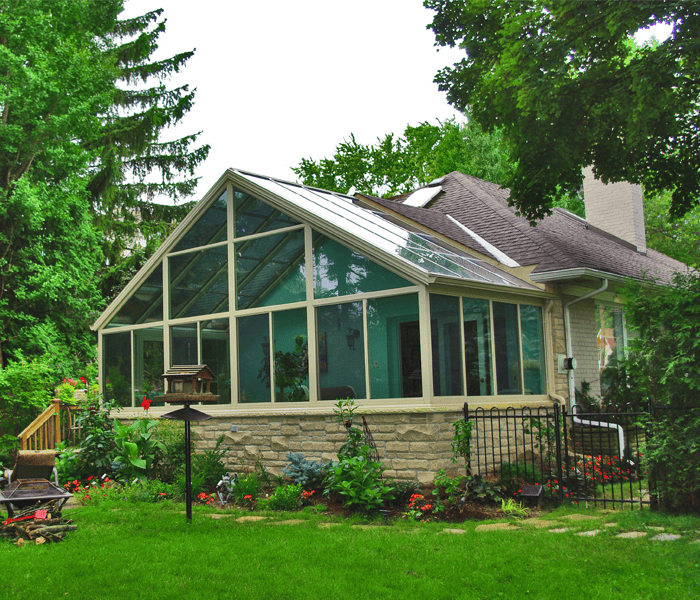
Houston homeowners aren’t short on outdoor space. What they’re short on is outdoor space they can actually use. Between the heat index pushing past 105°F from June through September, mosquitoes that make April through October feel like a contact sport, and humidity that turns a shaded porch into a steam room, most patios in Harris County sit empty for the better part of the year.
That’s the problem patio enclosures and sunrooms are built to solve — but not all of them solve it equally well. The right structure can turn your dead backyard square footage into the most-used room in your house. The wrong one becomes a leaking, overheating storage space you regret every time you pay the electric bill. We’ve seen both outcomes, and the difference usually comes down to decisions made before construction starts.
A three-season porch is exactly what it sounds like — an enclosed outdoor space designed for comfortable use in spring, summer, and fall. In most of the country, that’s a genuinely useful range. In Harris County, the math works differently.
Here, “three seasons” effectively means spring and fall, with maybe a few tolerable weeks on either end. The brutal stretch from June through September — when the heat index regularly hits 105°F to 110°F — makes a non-climate-controlled enclosure functionally unusable during those months. If you’re in Cypress, Katy, or Spring and you’re picturing yourself out there with a cup of coffee on a July morning, a standard three-season room isn’t going to get you there.
That doesn’t make three-season porches worthless in this market. For homeowners who primarily want to extend their spring and fall enjoyment — and aren’t expecting to use the space in peak summer — a three-season enclosure can be a cost-effective entry point. Just go in with accurate expectations about what you’re actually buying.
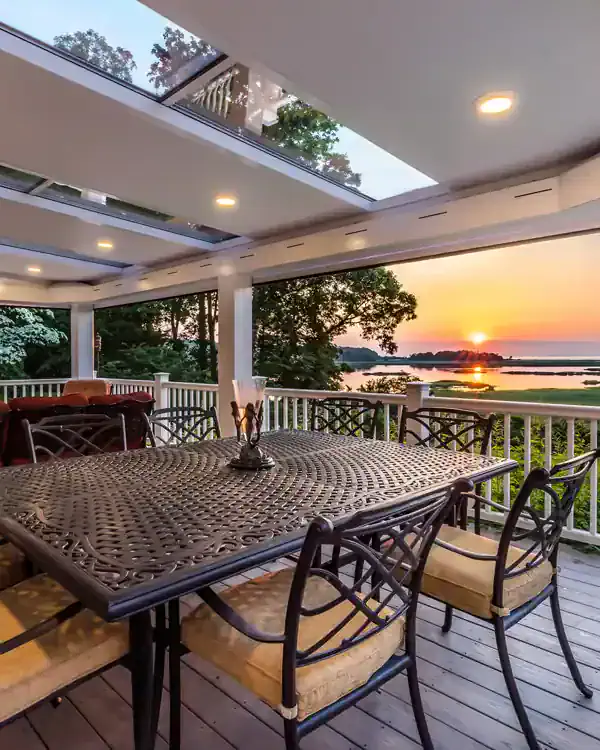
One of the most common questions we hear from Harris County homeowners is whether they can build a three-season sunroom porch on top of an existing deck. The short answer is: sometimes, but not without a proper assessment first.
The structural concern is load-bearing capacity. A standard residential deck is built to support people and outdoor furniture — not the additional weight of framed walls, a roof system, and glass or screen panels. Before any enclosure goes up, the existing deck needs to be evaluated by someone who actually knows what they’re looking at. If the framing and footings aren’t adequate, you’ll need reinforcement or a new concrete slab, which adds cost but also adds permanence and stability.
There’s also the drainage question. Houston averages about 50 inches of rain per year — one of the highest totals of any major U.S. city — and a lot of that comes in fast, heavy bursts. If your existing deck doesn’t have proper drainage slope and runoff management, enclosing it without addressing that first creates a water problem inside your new room.
The permit situation is worth mentioning here too. In Houston, converting a deck to an enclosed porch isn’t a minor project in the eyes of the city. Any structure that adds walls, windows, or a permanent roof is classified as a room addition, which means a full building permit through the Houston Permitting Center at 1002 Washington Avenue. If your deck is in an unincorporated part of Harris County rather than inside city limits, that goes through the Harris County Engineering Department instead — a distinction that trips up a lot of homeowners and contractors alike.
Beyond the city, if you’re in a master-planned community — Bridgeland, Fairfield, Cinco Ranch, or any of the dozens of HOA-governed neighborhoods across Cypress and Katy — you’ll also need architectural review approval before breaking ground. Getting that documentation right upfront saves you from having to tear down work you’ve already paid for.
The good news is that when a deck is properly assessed and the foundation is sound, it can absolutely serve as the base for a beautiful enclosed space. The key is doing the evaluation before you fall in love with a design.
When Houston homeowners start researching three-season patio enclosures, we usually see them land on the same fork in the road: glass walls or screen walls? Both have legitimate use cases, and the right answer depends on what you’re actually trying to solve.
A screen room is the more affordable option and it handles the bug problem extremely well. Harris County’s mosquito season runs from roughly April through October — seven months of the year — and a properly screened enclosure gives you full outdoor exposure without the assault. Screen rooms also allow for natural airflow, which matters in the shoulder seasons when the temperature is pleasant but the humidity is still high. The trade-off is that a screen room offers no real protection from heat. On a 95°F afternoon in Humble or Pasadena, you’re still sitting in 95°F air.
A glass three-season room adds a meaningful layer of weather protection. You’re shielded from rain, wind, and the worst of the direct sun, and the space feels more like a room than a porch. The catch is that standard glass — particularly single-pane glass — can turn an enclosed space into a greenhouse in Houston summers. Heat gain through uncoated glass is significant, and without the right glazing, you’ve essentially built a very expensive oven.
This is where glass selection becomes critical rather than cosmetic. The glass used in a three-season room determines whether the space is comfortable in April and October or whether it’s only tolerable on the handful of mild winter days Harris County gets each year. High-performance glass with UV-blocking and heat-transfer-reducing properties makes a measurable difference in how much of the year the room is actually usable.
Aluminum framing is the dominant material choice for both screen rooms and glass enclosures in the Houston market, and for good reason. An aluminum 3 season room handles humidity without warping, resists corrosion, and holds up to the wind loads required in Gulf Coast construction. An aluminum three-season room built with extruded (not roll-formed) aluminum and proper wind-rated connections is a durable structure. One built with cheaper roll-formed aluminum and minimal bracing is a future repair project.
Want live answers?
Connect with a Four Seasons Sunrooms Houston expert for fast, friendly support.
Cost is usually the first real question, and the honest answer is that the range is wide — wide enough that two quotes for “the same project” can differ by $30,000 or more without either contractor being wrong. The variables that drive sunroom cost per square foot in Houston include the type of structure, the glass system, foundation requirements, HVAC integration, and permit fees. Understanding each one helps you compare quotes intelligently instead of just picking the lowest number.
Nationally, the average sunroom addition runs around $47,000, with most projects landing between $22,000 and $75,000. In Harris County, where permit fees, site conditions, and labor costs reflect a large metro market, that range is realistic. Prefabricated three-season rooms can come in lower — sometimes as little as $6,000 to $15,000 for smaller footprints — but custom-built, climate-controlled four-season additions with premium glass and HVAC integration are a different category of investment entirely.
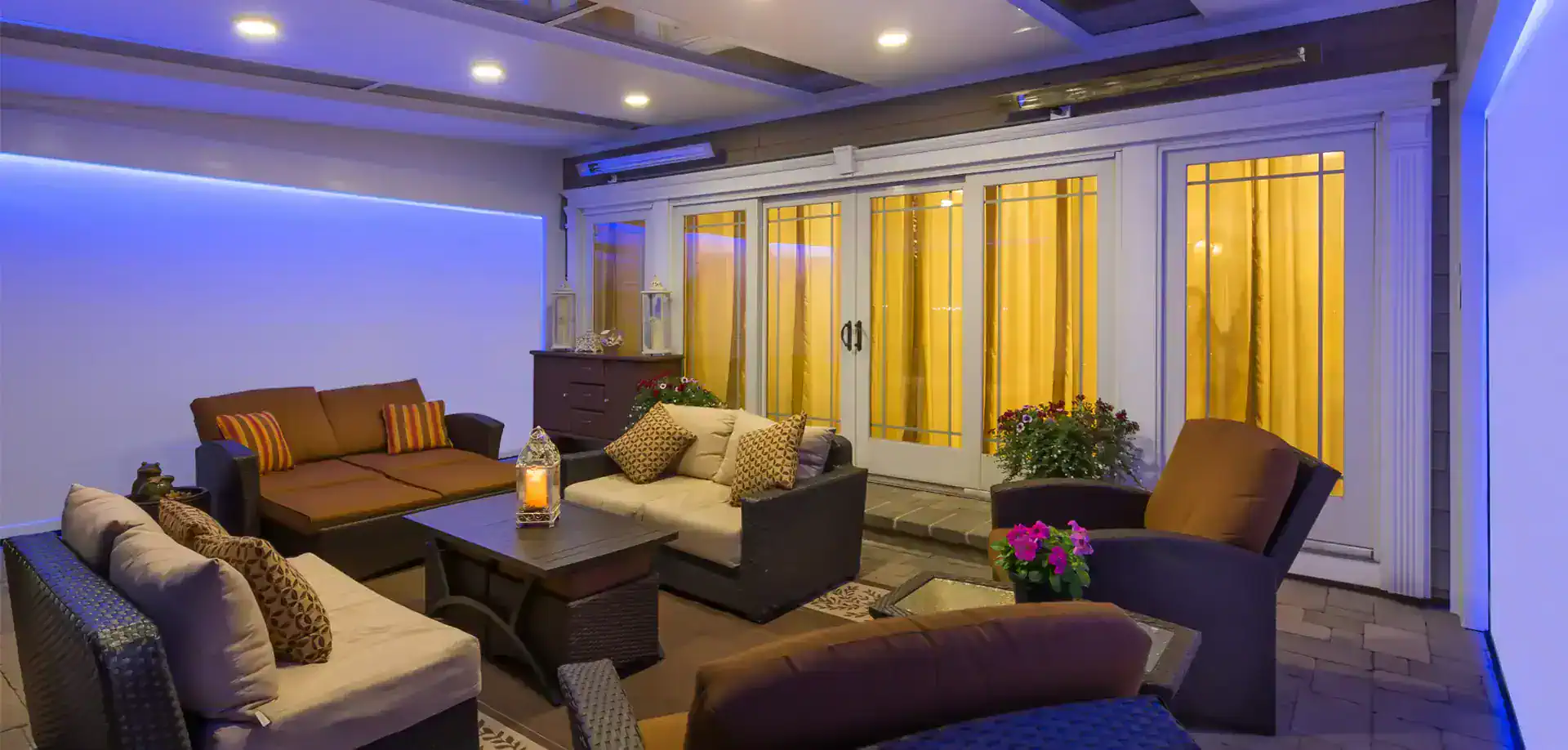
A fully climate-controlled four-season sunroom — one you can use on a 100°F July afternoon just as comfortably as a 60°F January morning — typically runs between $150 and $300 per square foot for a custom build. For a 200-square-foot addition, that puts you somewhere between $30,000 and $60,000 before accounting for site-specific factors.
What pushes a project toward the higher end of that range? A few things. Foundation work is one of the bigger variables. If you’re building on an existing concrete slab that’s in good condition, you may be able to use it. If you need a new slab or reinforced footings, add $1,000 to $6,000 depending on the scope. HVAC integration — extending your existing heating and cooling system into the new space — typically adds several thousand dollars and requires a licensed HVAC contractor separate from the sunroom installation.
Permit fees in Harris County generally run $250 to $1,500 for a project of this scope, and that’s a line item some contractors quietly leave out of their initial quotes. So does site preparation: grading, drainage adjustments, and landscaping protection can add 20 to 40 percent to a base quote when the site conditions require it. Before you sign anything, ask for a fully itemized estimate that includes foundation assessment, permits, HVAC, and site prep — not just the structure itself.
The four-season sunroom is the only option that genuinely solves the Houston summer problem. A three-season room gets you spring and fall. A four-season room with proper insulation, climate control, and high-performance glass gets you every month of the year. For a family in Clear Lake or Memorial who wants a breakfast room, a home office, or a space where the kids can play while you watch the rain come down, that year-round functionality is what justifies the investment.
Converting an existing three-season room to a four-season room is also possible if the structure is sound. That typically costs an additional $3,000 to $20,000 depending on what needs to change — new windows, added insulation, HVAC extension, and sometimes a foundation upgrade. It’s worth having that conversation before assuming you need to start from scratch.
If a fully climate-controlled sunroom is more than you want to spend right now, a three-season room is a legitimate middle ground — as long as you’re clear on what you’re getting. The average cost of a three-season room nationally runs from $8,000 to $30,000 for a conversion from an existing deck or patio. On a cost-per-square-foot basis, most three-season enclosures land between $80 and $150 per square foot, depending on materials and complexity.
A prefab three-season room sits at the lower end of that range. Prefabricated systems come with faster installation and a lower price tag, but they sacrifice design flexibility and, in many cases, structural performance. In Harris County, where structures need to meet Gulf Coast wind load requirements and handle significant annual rainfall, a prefab unit that was designed for a milder climate may not hold up the way a custom-built enclosure will. That’s not a knock on prefab across the board — it’s a reminder to ask specifically how any structure you’re considering is rated for wind and water infiltration.
A glass three-season room built with quality aluminum framing and proper glazing will cost more than a basic screen enclosure but significantly less than a full four-season addition. For a homeowner in Humble or Baytown who wants to extend their outdoor season from two usable months to five or six, that investment makes a lot of sense. For someone who wants to use the space in July, it doesn’t solve the core problem — and spending $15,000 to $25,000 on a room you can’t use in summer is a frustrating outcome.
The honest guidance is this: define what months you actually want to use the space before you choose a structure type. If it’s spring and fall only, a three-season room can deliver that at a reasonable price point. If you want year-round use, budget for a four-season addition from the start. Trying to retrofit climate control into a three-season structure after the fact almost always costs more than building it right the first time.
This is one of the most searched questions in the sunroom space, and the answer for Houston is unambiguous: yes, permits are required. Any covered patio enclosure or sunroom that adds walls, windows, or a permanent roof is classified as a room addition under Houston’s adopted building code, which means a full building permit with plan review through the Houston Permitting Center. Applications go through the iPermits online portal. If your property is in unincorporated Harris County rather than inside Houston city limits, the permitting authority shifts to the Harris County Engineering Department — same requirement, different office.
Skipping permits isn’t a technicality — it’s a real risk. Unpermitted additions are one of the most common deal-killers when Houston homeowners go to sell. They can also create gaps in your homeowner’s insurance coverage if the structure is damaged in a storm. After Hurricane Harvey, a lot of Harris County homeowners found out the hard way that unpermitted structures weren’t covered. A contractor who tells you a patio enclosure doesn’t need a permit is either uninformed or hoping you won’t ask questions.
Every project we build is fully permitted, inspected, and code-compliant. That’s not a selling point — it’s the baseline for doing this work responsibly. If you’re ready to talk through what the right enclosure looks like for your home and your budget, we’re straightforward about costs, timelines, and what the permit process actually involves. Reach out to us and let’s start with a real conversation.
Summary:
Article details:
Share: